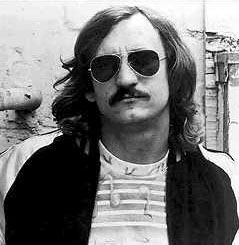
A few weeks back I decided to grow a moustache as a kind of novelty. I stopped shaving for a week or so and then removed all hair save that which befits a typical moustache of the kind my dad or Joe Walsh would have had back in the '70s. Late that afternoon I went to the gym for in my daily pursuit of reversing all the time I spend sitting each day. I went to the locker room to shower and as I was getting dressed, a young man approached me. He then quietly asked if he could perform oral sex on me. Stupefied, all I could say was something like a quick 'um...no.' Then he ran off.
What? Come on. I could hardly believe this solicitation. Immediately, I connected the dots, lamenting that in this new millennium, it is clearly out of bounds for a heterosexual man to wear a moustache. I mean, what about Dennis Hopper from Easy Rider or Goose from Top Gun? My dad and his generation didn't know how well they had it. Here, in this day I have unassumingly wandered into some kind of discreet cruising code and I had managed to have given off the impression I was keen to have a covert encounter.
The same evening, I was taking my lady friend out to an Old 97s show in downtown LA. It was great show by the way. As we walked to the venue holding hands, we approached a homeless fellow/troubadour rapper/street performer. As he saw us he called out "yeah! alright that's a man right there taking care of his lady!" A few more steps then changed his tune into a kind of syncopated "whoa!! not the moustache, aww man, you cant do that, you got to shave that off brother!"
That's when I decided that the moustache had come to the end of its 9 hour run.
Such is the fickle hand (face?) of fashion. One day, LA will be free of moustache discrimination.
Wednesday, July 30, 2008



Thursday, December 6, 2007
Assorted bus tales #1
About a month and a half ago I hopped on the old BBB#1 to go to UCLA. BBB is the Big Blue Bus, or as I call it the Santa Monica Limo Service or SMLS - "smiles!" It's always an interesting ride. This particular afternoon I decided I wanted to go to a lecture by Amartya Sen. He is easily one of the most important minds of the last 50 years. Nobel Prize? Got it. Books? yes, sold tens of thousands (which is pretty good for an economist). Honorary doctorates from all over the world? Check, 87 of 'em. Married to Rothschild banking family? mm hmm. Hot actress daughter? that too. Guy is pretty slick. A rockstar. I'm pretty excited.
So the bus rolls up and this old homeless fellow slowly saunters on board the bus. He is stooped so far over it looks like standing is difficult. He is wearing 2 shirts and 1 and a half jackets. The bus driver was hassling him for something, probably because he didnt seem to notice that he had to pay a fee to ride. I couldnt tell, I had my ipod blasting Propagandhi. So as he shuffles down, I notice people immediately get up and scurry toward the back of the bus. Others squint and make disgusted faces. Then the smell hits me. It literally smells like old shit. Everywhere. All over the bus. For some reason the guy walks past all of the seats that have now opened up and sits next to this guy who is right out of the mid-west. I can tell this by his t-shirt advertising a bar in milwaukee. He looks like norm from Cheers. Norm can hardly believe this. After about 10 seconds he gets up, squeezes past the homeless man, who is now hunched over to one side and threatening to collapse into the aisle. This commotion seems to awaken him and he soon stands up in the aisle, purposefully leaning against the support rail.
It then becomes clear to me that he is also wearing pants. Or rather trying to wear pants. They have fallen down to mid-thigh. He is not wearing underwear. In a few minutes, people begin to yell from the back of the bus that he sit back down. After a while he does - with stern encouragement from the bus driver. Meanwhile the smell is overwhelming. He is 3 rows in front of me. I turn up my Propagandi as if it will cover up the smell. In my day I've smelled some bad things. Open sewers. Burning garbage. A fridge shared by 10 people. Bathrooms during and after Cinco de Mayo. This was really testing me though.
As we approached Wilshire the homeless fellow became restless. "Imgettingoffhereletmeoff!!" he yelled toward the person across from him. He slowly stood up and stood in the aisle again. He stood next to a clean cut middle aged man wearing a brown fleece jacket and bright green Crocs shoes. This guy was also listening to his ipod. Slowly the homeless guy shifted his weight and in a moment his bare ass was less than a foot from this guy's face. It was probably there for about 2 minutes. I wonder what was going through that man's head during that time, which must have seemed like years. Once we got to the Wilshire stop, the homeless man slowly sauntered to the back exit adjacent to where I was sitting. The smell sharpened. I turned up my ipod. I think it was Flogging Molly on there then. He continued and made his way out of the bus very slowly.
About 20 minutes later I'm in the Humanities building lecture hall. Time to see Sen. I'm there with some of my grad student colleagues. We're pretty pumped. This guy is huge. The lecture hall quickly fills up. There are about 200 of us there to see him. He is old. He stoops slightly and was wearing a tweed coat that was too large for him, making it resemble a cape. Sen walks up to the podium. We lean forward as he prepares to speak.
"Do you have a microphone? I need a microphone to speak here" he says thoughtfully in his Oxbridge tinged British accent.
Of course! That would help. He is 80 years old and is going to speak to a huge room of people. He may need a microphone. 10 PhDs who did not anticipate this suddenly spring to action. From a small cabinet they retrieve a microphone that looks like a dog collar. A classics professor places it around Sen's neck. Others adjust the PA system.
Sen speaks. He sounds like Stephen Hawking speaking on a telephone in a snowstorm. Sen doesnt know this and begins his lecture. He talks about Social Choice Theory, walks around a bit, mentions John Rawls a few times and writes on the chalkboard. After 20 minutes I realize I have no idea what the hell he is talking about, simply because it is totally indecipherable through the buzzing robotic gibberish that his swingining microphone is occasionally relaying to the PA system. The audience seems anxious. Some one adjusts the PA cabinet. A while later someone moves the microphone and clips it closer to Sen's head. His new dance partners come and go intermittently for the next 30 minutes. Each intervention is an interruption. Once, while walking to the board, the dog collar microphone tenses and jerks the nobel laureate toward the PA cabinet. He nearly loses his footing. PhDs jump forth. I look around me and shake my head. "Amartya Sen, no microphone. Are you serious?" I say. Sen recovers and coolly tells the audience, "when I was growing up in my village in India, I had a goat that would do the same thing when I pulled its collar." Everyone laughs.
This mess continues for the next 15 minutes until Sen has finished his talk. At one point he calmly says something to the effect of "I've never seen so much effort expended in order to NOT shut me up." More laughter. What a let down. He probably made thousands of dollars to come to UCLA and basically speak to himself.
Interesting afternoon though. The homeless man and Amartya Sen. Such different people, couldnt be much further apart in many senses. Juxtaposed. Sen probably wont be back anytime soon after his hosts did such a good job of making him look like a total fool. If so, maybe they'll forget to pick him up from the airport. Then perhaps i'll see him on the bus.
So the bus rolls up and this old homeless fellow slowly saunters on board the bus. He is stooped so far over it looks like standing is difficult. He is wearing 2 shirts and 1 and a half jackets. The bus driver was hassling him for something, probably because he didnt seem to notice that he had to pay a fee to ride. I couldnt tell, I had my ipod blasting Propagandhi. So as he shuffles down, I notice people immediately get up and scurry toward the back of the bus. Others squint and make disgusted faces. Then the smell hits me. It literally smells like old shit. Everywhere. All over the bus. For some reason the guy walks past all of the seats that have now opened up and sits next to this guy who is right out of the mid-west. I can tell this by his t-shirt advertising a bar in milwaukee. He looks like norm from Cheers. Norm can hardly believe this. After about 10 seconds he gets up, squeezes past the homeless man, who is now hunched over to one side and threatening to collapse into the aisle. This commotion seems to awaken him and he soon stands up in the aisle, purposefully leaning against the support rail.
It then becomes clear to me that he is also wearing pants. Or rather trying to wear pants. They have fallen down to mid-thigh. He is not wearing underwear. In a few minutes, people begin to yell from the back of the bus that he sit back down. After a while he does - with stern encouragement from the bus driver. Meanwhile the smell is overwhelming. He is 3 rows in front of me. I turn up my Propagandi as if it will cover up the smell. In my day I've smelled some bad things. Open sewers. Burning garbage. A fridge shared by 10 people. Bathrooms during and after Cinco de Mayo. This was really testing me though.
As we approached Wilshire the homeless fellow became restless. "Imgettingoffhereletmeoff!!" he yelled toward the person across from him. He slowly stood up and stood in the aisle again. He stood next to a clean cut middle aged man wearing a brown fleece jacket and bright green Crocs shoes. This guy was also listening to his ipod. Slowly the homeless guy shifted his weight and in a moment his bare ass was less than a foot from this guy's face. It was probably there for about 2 minutes. I wonder what was going through that man's head during that time, which must have seemed like years. Once we got to the Wilshire stop, the homeless man slowly sauntered to the back exit adjacent to where I was sitting. The smell sharpened. I turned up my ipod. I think it was Flogging Molly on there then. He continued and made his way out of the bus very slowly.
About 20 minutes later I'm in the Humanities building lecture hall. Time to see Sen. I'm there with some of my grad student colleagues. We're pretty pumped. This guy is huge. The lecture hall quickly fills up. There are about 200 of us there to see him. He is old. He stoops slightly and was wearing a tweed coat that was too large for him, making it resemble a cape. Sen walks up to the podium. We lean forward as he prepares to speak.
"Do you have a microphone? I need a microphone to speak here" he says thoughtfully in his Oxbridge tinged British accent.
Of course! That would help. He is 80 years old and is going to speak to a huge room of people. He may need a microphone. 10 PhDs who did not anticipate this suddenly spring to action. From a small cabinet they retrieve a microphone that looks like a dog collar. A classics professor places it around Sen's neck. Others adjust the PA system.
Sen speaks. He sounds like Stephen Hawking speaking on a telephone in a snowstorm. Sen doesnt know this and begins his lecture. He talks about Social Choice Theory, walks around a bit, mentions John Rawls a few times and writes on the chalkboard. After 20 minutes I realize I have no idea what the hell he is talking about, simply because it is totally indecipherable through the buzzing robotic gibberish that his swingining microphone is occasionally relaying to the PA system. The audience seems anxious. Some one adjusts the PA cabinet. A while later someone moves the microphone and clips it closer to Sen's head. His new dance partners come and go intermittently for the next 30 minutes. Each intervention is an interruption. Once, while walking to the board, the dog collar microphone tenses and jerks the nobel laureate toward the PA cabinet. He nearly loses his footing. PhDs jump forth. I look around me and shake my head. "Amartya Sen, no microphone. Are you serious?" I say. Sen recovers and coolly tells the audience, "when I was growing up in my village in India, I had a goat that would do the same thing when I pulled its collar." Everyone laughs.
This mess continues for the next 15 minutes until Sen has finished his talk. At one point he calmly says something to the effect of "I've never seen so much effort expended in order to NOT shut me up." More laughter. What a let down. He probably made thousands of dollars to come to UCLA and basically speak to himself.
Interesting afternoon though. The homeless man and Amartya Sen. Such different people, couldnt be much further apart in many senses. Juxtaposed. Sen probably wont be back anytime soon after his hosts did such a good job of making him look like a total fool. If so, maybe they'll forget to pick him up from the airport. Then perhaps i'll see him on the bus.
Tales from Rt 66
Long time, no post. So tonight I walked to the store to pick up some granola for breakfast tomorrow. I live about 2 blocks from the store. As I was returning home, walking down Santa Monica Boulevard, a black Mazda pulled up next to me. I immediately thought to myself to prepare for the coming "how do I get to" question. However, the driver - a middle aged white man- asked if I "wanted a ride." The first time he asked I pretended not to hear, as he spoke softly and I thought he must have been talking to someone else. Like a small kid that was walking behind me (there was no small kid walking behind me). I turned and told him that I did not want a ride. He sped up and continued down the street. I was about a block from home.
Are you kidding me? Who asks a total stranger if they want a ride? It wasnt raining, and I dont think I appeared incapable of handling one loosely filled plastic grocery bag. I felt this guy must have thought I was like 10. I dont think I look this young. I havent been carded in a while.
Are you kidding me? Who asks a total stranger if they want a ride? It wasnt raining, and I dont think I appeared incapable of handling one loosely filled plastic grocery bag. I felt this guy must have thought I was like 10. I dont think I look this young. I havent been carded in a while.
Wednesday, August 1, 2007
Road Warrior
Recently the American Society of Civil Engineers (ASCE) began a public policy awareness campaign to warn the general public about the state of public works infrastructure across the US. Most of the bridges, roads, dams, canals, channels and electric grid infrastructure was built between the 1930s and 1960s. Presently much of it is in disrepair. The ASCE points to a general crumbling of much of the infrastructure that has supported the travel, commerce and industrial (even suburban residential) development that has catapulted the US to unrivaled standards of living and wealth accumulation over the past 70 years.
Sadly today, a bridge in Minnesota (built in 1967) collapsed into the river it spanned, killing 7. Minnesota is flat. It has no earthquake problems, is not plagued by tropical storms or rampant annual flooding. The bridge simply wore out and collapsed into the Mississippi River - the first major geographic obstacle to be conquered by continental explorers more than 200 years ago in the settlement of the American West.
Replacing or repairing the countless bridges, overpasses, miles of state and federal highways, flood control devices and other infrastructure that ensconce our country will cost untold billions. Much of it was constructed in the (now seemingly) strange political mandate drawn by FDR to expand government, borrow money, subsidize favorable industries and employ tens of thousands of Americans in the most ambitious public works initiatives in human history. One of my favorite history professors I had as a young bronco impressed this point upon me: the most costly (in all senses of the word) things a civilization can do is 1)build roads and 2)make war. I like to think there is a strong metaphorical analogy to our present situation in Iraq... but that is a separate discussion.
The political will and the pluck and determination - hallmarks of this past "greatest generation" I fear will not be replicated today. The present state American labor unions, the structure of corporations, the already crippling public bond debt many cities and states have, our increasing reliance on what is essentially a helot labor force will impede any broad-based support for passing and implementing bills that will rejuvenate our ailing infrastructure.
I suppose there is always the possibility to privately finance some of these projects. Some of these fee-based facilities are already here in Orange County. I reflected upon a recent experience in the entry below.
Sadly today, a bridge in Minnesota (built in 1967) collapsed into the river it spanned, killing 7. Minnesota is flat. It has no earthquake problems, is not plagued by tropical storms or rampant annual flooding. The bridge simply wore out and collapsed into the Mississippi River - the first major geographic obstacle to be conquered by continental explorers more than 200 years ago in the settlement of the American West.
Replacing or repairing the countless bridges, overpasses, miles of state and federal highways, flood control devices and other infrastructure that ensconce our country will cost untold billions. Much of it was constructed in the (now seemingly) strange political mandate drawn by FDR to expand government, borrow money, subsidize favorable industries and employ tens of thousands of Americans in the most ambitious public works initiatives in human history. One of my favorite history professors I had as a young bronco impressed this point upon me: the most costly (in all senses of the word) things a civilization can do is 1)build roads and 2)make war. I like to think there is a strong metaphorical analogy to our present situation in Iraq... but that is a separate discussion.
The political will and the pluck and determination - hallmarks of this past "greatest generation" I fear will not be replicated today. The present state American labor unions, the structure of corporations, the already crippling public bond debt many cities and states have, our increasing reliance on what is essentially a helot labor force will impede any broad-based support for passing and implementing bills that will rejuvenate our ailing infrastructure.
I suppose there is always the possibility to privately finance some of these projects. Some of these fee-based facilities are already here in Orange County. I reflected upon a recent experience in the entry below.
Tuesday, July 31, 2007
Engineered Congestion
Dear TCA Administrator,
I've just returned from spending 1hr waiting to exit the Southbound 73 at Bonita Canyon. Due to the construction work, the Macarthur and Buffalo exits that I normally use were closed. There was no signage indicating that these exists were closed. I, along with several hundred other drivers, backed up to the nearest exit slowly crawled along so that we would have the privilege of depositing 75 cents into the toll collection bin. Hopefully this toll money can be used to purchase proper signage to warn drivers that the exits they use everyday will be out of service. This problem has also occurred on the 5-N on ramp from 133-E.
I understand this road has to finance itself through toll collection, but situations like this - where it appears you have deceived drivers into having to pay a toll - do not bode well for the public perception of your organization.
I've just returned from spending 1hr waiting to exit the Southbound 73 at Bonita Canyon. Due to the construction work, the Macarthur and Buffalo exits that I normally use were closed. There was no signage indicating that these exists were closed. I, along with several hundred other drivers, backed up to the nearest exit slowly crawled along so that we would have the privilege of depositing 75 cents into the toll collection bin. Hopefully this toll money can be used to purchase proper signage to warn drivers that the exits they use everyday will be out of service. This problem has also occurred on the 5-N on ramp from 133-E.
I understand this road has to finance itself through toll collection, but situations like this - where it appears you have deceived drivers into having to pay a toll - do not bode well for the public perception of your organization.
Monday, July 30, 2007
The grass is always greener...
On my way back home from the Simpsons movie, I drove next to the golf course near my house. The site of the golf course used to be a landfill. After years of subterranean methane extraction the area was deemed safe (underground methane pockets from decaying trash are prone to explode) for the construction of the golf course and surrounding condominiums and apartments. This evening, the grass was being watered. Unfortunately, the sprinkler had pointed itself at the road and sprayed continuously away from the grass and onto the lane upon which I traveled. This no doubt bathed my car in a soft cloud of tiny water droplets which right now are probably collecting the pollen and dust in the air; ready to dry up, leave their stowaways behind and thus completely eliminate any sign that I did in fact wash my car this weekend.
But I digress (actually this whole blog is a sort of digression). When I was 9 I learned that plants need water, soil and sunlight to grow and survive. I have taken these lessons to heart and have become the steward of a bamboo shoot that lives in a vase on top of my guitar amplifier. After about 2 years, the bamboo seemed to be lagging (read: dying). I thought it would be a good idea to "mix it up" by placing the core of a pear in the vase for the afternoon - perhaps the pear would offer special "plant regenerative enzymes" that would stimulate growth and fight the build up of unsightly brown areas on the leaves.
Actually it appears the pear has totally destroyed the vase ecosystem as the plant now reeks of decay. Furthermore, the stem has become yellow and brittle and it appears eminent that my bamboo will die. Very sad.
So as I passed the golf course that was supposed to be receiving its water, I thought to myself "whose running the show here?" Its night. How can a plant use water without the sun? How can it do the photosynthesis? It will be dry and thirsty (and probably dusty and dirty like my car) when the first rays of sunshine reach the those manicured blades. On top of that, the grass is growing on top of a 3 square mile trash dump. I already know what one discarded pear can do, but a whole landfill? That cant be good. Nor can the water treatment facility and settling ponds located across the street from this.
Give a hoot don't pollute.
But I digress (actually this whole blog is a sort of digression). When I was 9 I learned that plants need water, soil and sunlight to grow and survive. I have taken these lessons to heart and have become the steward of a bamboo shoot that lives in a vase on top of my guitar amplifier. After about 2 years, the bamboo seemed to be lagging (read: dying). I thought it would be a good idea to "mix it up" by placing the core of a pear in the vase for the afternoon - perhaps the pear would offer special "plant regenerative enzymes" that would stimulate growth and fight the build up of unsightly brown areas on the leaves.
Actually it appears the pear has totally destroyed the vase ecosystem as the plant now reeks of decay. Furthermore, the stem has become yellow and brittle and it appears eminent that my bamboo will die. Very sad.
So as I passed the golf course that was supposed to be receiving its water, I thought to myself "whose running the show here?" Its night. How can a plant use water without the sun? How can it do the photosynthesis? It will be dry and thirsty (and probably dusty and dirty like my car) when the first rays of sunshine reach the those manicured blades. On top of that, the grass is growing on top of a 3 square mile trash dump. I already know what one discarded pear can do, but a whole landfill? That cant be good. Nor can the water treatment facility and settling ponds located across the street from this.
Give a hoot don't pollute.
Sunday, July 29, 2007
Walden Pond Theater
Movie theaters ostensibly show movies to a paying audience. They also play stage to a more subtle dynamic that lies behind the films shown on the screen.
There's a seen in the new Simpsons movie where in a moment of collective panic about the expected Armageddon, Reverend Lovejoy's flock runs out of the church to the tavern, passing Moe the Bartender's regulars who leave the tavern headed in the opposite direction. The brief scene is a clever quip about the nuanced ironies of morality and immorality; the beliefs and expectations of each placed against the actual exercise of such behavior.
Before the movie, the Will Rogers Institute, a foundation that raises money to pay for medical research and student fellowships, runs an advertisement asking moviegoers to contribute to their charitable work by purchasing a "combo pack" from the theater snack bar.
The fare at most theaters consists of hot dogs, nachos, sodas, slurpees (alas no Squishee) popcorn and all types of other foods made of refined sugars, or replete with preservatives that protect the food until it is microwaved into readiness for consumption. So, by buying a combo pack, which would provide the consumer a sample of much of these kinds of foods, the Will Rogers Institute acquires money to help pay for the training of new doctors. A worthy cause. Even more impressive is that through consumption of the food and the combination of sitting idly in a theater for 2 hours, the charity donor is placing their health in a position that may require future medical treatment for chronic disorders (diabetes, heart disease, tooth decay).
Such is this complex symbiotic relationship. The number of doctors increases as the number of potential patients also increases. Seems like a natural thing. But you dont have to take my word for it....
"You only need sit still long enough in some attractive spot in the woods that all its inhabitants may exhibit themselves to you by turns."
-Thoreau, Walden
There's a seen in the new Simpsons movie where in a moment of collective panic about the expected Armageddon, Reverend Lovejoy's flock runs out of the church to the tavern, passing Moe the Bartender's regulars who leave the tavern headed in the opposite direction. The brief scene is a clever quip about the nuanced ironies of morality and immorality; the beliefs and expectations of each placed against the actual exercise of such behavior.
Before the movie, the Will Rogers Institute, a foundation that raises money to pay for medical research and student fellowships, runs an advertisement asking moviegoers to contribute to their charitable work by purchasing a "combo pack" from the theater snack bar.
The fare at most theaters consists of hot dogs, nachos, sodas, slurpees (alas no Squishee) popcorn and all types of other foods made of refined sugars, or replete with preservatives that protect the food until it is microwaved into readiness for consumption. So, by buying a combo pack, which would provide the consumer a sample of much of these kinds of foods, the Will Rogers Institute acquires money to help pay for the training of new doctors. A worthy cause. Even more impressive is that through consumption of the food and the combination of sitting idly in a theater for 2 hours, the charity donor is placing their health in a position that may require future medical treatment for chronic disorders (diabetes, heart disease, tooth decay).
Such is this complex symbiotic relationship. The number of doctors increases as the number of potential patients also increases. Seems like a natural thing. But you dont have to take my word for it....

"You only need sit still long enough in some attractive spot in the woods that all its inhabitants may exhibit themselves to you by turns."
-Thoreau, Walden
Subscribe to:
Posts (Atom)